
Dawson Trail Dispatch, written by Norm Gregoire, February 2026
Page 8 https://issuu.com/dispatch222/docs/dawson_trail_dispatch_february_2026
Many years ago, while I was working in the Rockies, I had a unique wildlife experience. After guiding a full-day hike, I was driving guests back to their hotels. It was a very quiet ride as all had fallen asleep. Suddenly a shape walked out in front of the vehicle: a cougar! I slammed on the brakes, and although I can’t remember what I had said, I know I was ecstatic. The guests looked around, but the big cat was already gone. One of them asked if we would see another cougar, not knowing what a rare sighting it was. I replied with a very opportunistic “There’s always a chance!”. That was the first and last cougar I have ever seen.
Since I have moved back to Manitoba, I have heard of more encounters with cougars than what I can remember as a child. My wife saw a cougar only a few kilometres from our house. We also have the chance to see other wildcats like the bobcat and lynx. These rare felines share the landscape with us but are seldom seen. Due to the rarity of a sighting, we tend not to think about these animals as much as we would a more commonly sighted creature, so there is a lot to learn about the wildcats of Manitoba.
Let’s start with the cougar, also known as a mountain lion, puma, and a host of other names. Cougars have the largest selection of common names of any mammal. One reason for this is they have the most widespread range of any large land mammal in the Western Hemisphere, from Yukon to the South American Andes. Each region has a specific name they commonly use for Puma concolor.
Although a cougar sighting is rare in Manitoba, if you are lucky enough to catch a glimpse, they are unmistakable. Averaging over one hundred pounds with a tail that is one-third of the total body length, these are impressive creatures. They are top predators who can reach speeds of eighty kilometres per hour and hold the record for the highest standstill jump of any predator: over seven meters! Prey varies depending on where the cougar’s range is, but in Manitoba it is thought that white-tailed deer would be a preferred target.
Although cougars certainly exist in Manitoba, there remains some debate as to their official status in the province. There are many photos, videos, and accounts of seeing cougars across a wide geographic area; however, it is still unknown if there are breeding adults raising kittens in Manitoba. This is a key factor in being able to move cougars from being “data deficient” in Manitoba. If the uptick of sightings continues, there is a good chance kittens will be detected, and the question of if the cougar is a breeding species or not will be put to bed.
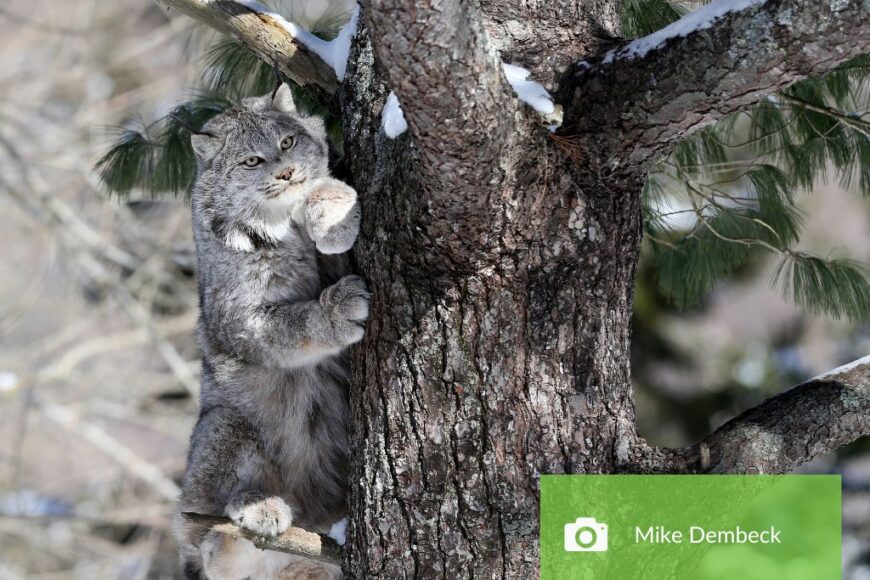
A quick note on the other felines of Manitoba the bobcat and lynx. Although very similar in appearance, the lynx is slightly larger than the bobcat, and the lynx has more pronounced black tips on the ears. These felines share a range throughout the border region of Canada and the USA, where the lynx will generally range north and the bobcat south. With a size on average of one-third the size of a cougar, they are generally looking for smaller prey, such as snowshoe hare.
Seeing any wildcat in Manitoba can be a once-in-a-lifetime experience; it’s time with nature that you won’t forget. Even though they are rare to see, I take great pride in living in an area where it is still possible for these wildcats of Manitoba to be seen.
Adventures with Nature Norm
To learn more about wildcats of Manitoba, please join me on the next Adventures with Nature Norm on February 28th from 10am to 12pm at the Weston Family Tall Grass Prairie Interpretive Centre. Please contact info@sharedlegacymb.ca for more information. See you there!